7 Must-Have Contractor Website Features to Win Jobs
Upgrade your contractor website with features designed to convert visitors into paying clients. We cover the essential tools that will help you book more jobs.
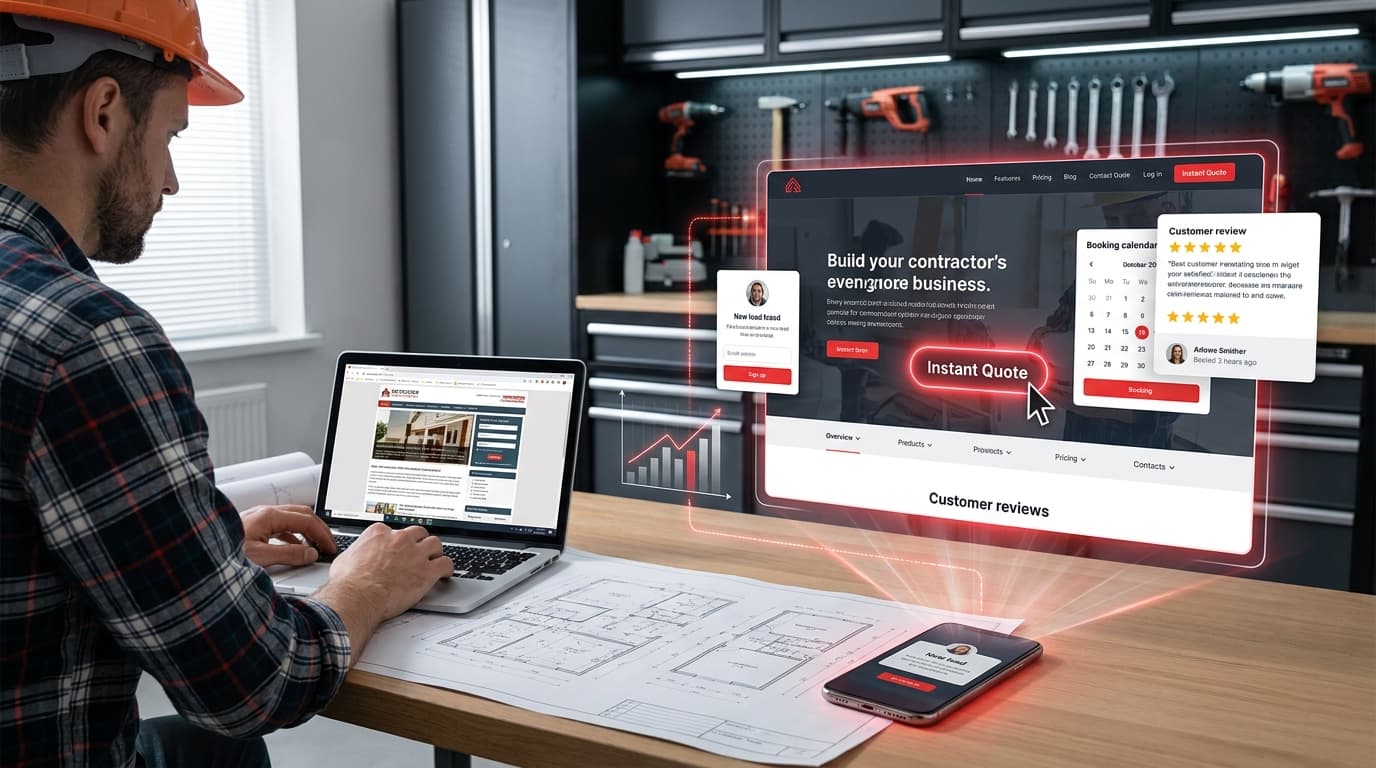
Is your website working as hard as you do? For many contractors and service business owners, a website is just a digital business card—a placeholder on the internet. But what if it could be your best salesperson, working 24/7 to qualify leads, build trust, and book jobs?
A well-designed contractor website does more than just list your services; it actively converts visitors into paying customers. The difference between a site that sits idle and one that generates consistent leads often comes down to a few key features. By implementing the right tools and design elements, you can transform your online presence from a simple brochure into a powerful business-generating machine.
Here are the seven essential website features every contractor needs to stand out from the competition and win more jobs.
1. Prominent Contact Info & Clear Calls-to-Action (CTAs)
This might sound basic, but it’s the single most common mistake we see on service business websites. If a potential customer can't figure out how to contact you within three seconds of landing on your page, they're gone—likely to a competitor's site. Don't make them hunt for your phone number.
How to Get it Right:
- Header and Footer: Your phone number should be clearly visible in the top right corner of your website's header on every single page. It should also be listed in the footer.
- Click-to-Call: On mobile devices, your phone number should be a clickable link that immediately opens the user's phone app. This simple feature removes friction and dramatically increases calls.
- Strong CTA Buttons: Don't just say "Contact Us." Use clear, action-oriented language on your buttons like "Request a Free Estimate," "Schedule a Consultation," or "Get a Quote Now." These buttons should be visually distinct with a contrasting color that draws the eye.
2. A High-Quality Project Gallery
For any trade that produces a visual result—from roofing and remodeling to landscaping and painting—a picture is worth a thousand words. Your craftsmanship is your biggest selling point, and a project gallery is where you prove it. Stock photos won't cut it; potential clients want to see your actual work.
Best Practices for Your Gallery:
- Before & After Photos: This is the gold standard. Showing the transformation you delivered is incredibly powerful and helps clients visualize the potential for their own project.
- High-Resolution Images: Blurry, poorly lit photos taken on an old phone can do more harm than good. Invest in a decent smartphone or a professional photographer to capture your work in its best light.
- Organize by Service: Don't just dump all your photos onto one page. Create categories for different types of work (e.g., "Kitchen Remodels," "Deck Construction," "Bathroom Tiling"). This helps visitors find relevant examples and improves your site's SEO.
3. Customer Reviews and Testimonials
Social proof is the modern-day word-of-mouth. In an industry built on trust, what your past customers say about you is far more persuasive than what you say about yourself. Integrating reviews directly onto your site builds instant credibility and helps hesitant prospects feel confident in choosing you.
How to Leverage Reviews:
- Automated Review Widgets: Use tools that automatically pull in your latest 5-star reviews from platforms like Google, Yelp, or Angi. This keeps the content fresh and authentic.
- Dedicated Testimonials Page: Create a page that showcases your best reviews, complete with the customer's name and city (with their permission).
- Sprinkle Them Everywhere: Don't just hide reviews on one page. Place a powerful quote on your homepage, add a relevant testimonial to each service page, and position a glowing review right next to your contact form.
4. Detailed, Individual Service Pages
Having a single "Services" page with a bulleted list is a huge missed opportunity for SEO. When a homeowner in your area searches for "emergency plumbing repair" or "custom deck builder," Google looks for the most relevant page to match that specific query. A dedicated page for each service is far more relevant than a generic list.
Each service page should include:
- A detailed description of the service.
- Photos of completed projects related to that service.
- Answers to frequently asked questions (FAQs).
- A specific call-to-action to request a quote for that service.
This strategy not only helps you rank higher in search results for specific keywords but also provides potential customers with the detailed information they need to make a decision.
5. An Instant Quote Calculator or Smart Estimate Form
Want to turn your website into a lead-capture powerhouse? Add an interactive quote calculator or a detailed estimate form. This feature is a win-win: the customer gets an immediate, ballpark idea of cost, and you get a highly qualified lead with specific project details delivered right to your inbox.
This doesn't have to be a complex, perfectly accurate pricing tool. It can be a simple form that asks a series of questions (e.g., square footage, material choice, project scope) and provides a rough estimate while capturing the user's name, email, and phone number for follow-up.
6. Online Booking or Scheduling Integration
Reduce the endless phone tag required to schedule an estimate. By integrating a simple scheduling tool like Calendly or Acuity, you can allow potential clients to see your availability and book a consultation directly on your website. This empowers the customer and saves you significant administrative time. You can set rules for when appointments can be booked, how long they last, and what information you need upfront, streamlining your entire lead management process.
7. A Mobile-First, Responsive Design
This isn't just a feature anymore; it's a requirement. Over 60% of website traffic now comes from mobile devices. Homeowners are searching for contractors on their phones while at work, on the couch, or even standing in the room they want to be renovated. If your website is difficult to navigate on a smartphone—requiring pinching, zooming, and frustrated tapping—you are losing business. Period.
A responsive website automatically adjusts its layout to fit any screen size, from a large desktop monitor to a small smartphone. This ensures a seamless, professional experience for every visitor, no matter how they find you.
Your Website Should Be Your Hardest-Working Employee
Your website has the potential to be so much more than a digital business card. By implementing these seven essential features, you can transform it into a lead-generating asset that builds trust, qualifies customers, and consistently fills your project pipeline.
Investing in a strategic, feature-rich website isn't an expense—it's an investment in the growth and efficiency of your business. It works around the clock to ensure that when a potential customer needs your services, you're the first and best choice they find.
Ready to turn your contractor website into a lead-generating machine? Contact Gray Tech Solutions today for a free consultation and let's build a site that wins you more jobs.