AEO for Home Service Businesses: Get Found in ChatGPT and Google AI Overviews
What is AEO (Answer Engine Optimization)? A practical guide for contractors and home service pros on getting recommended when homeowners search with AI.
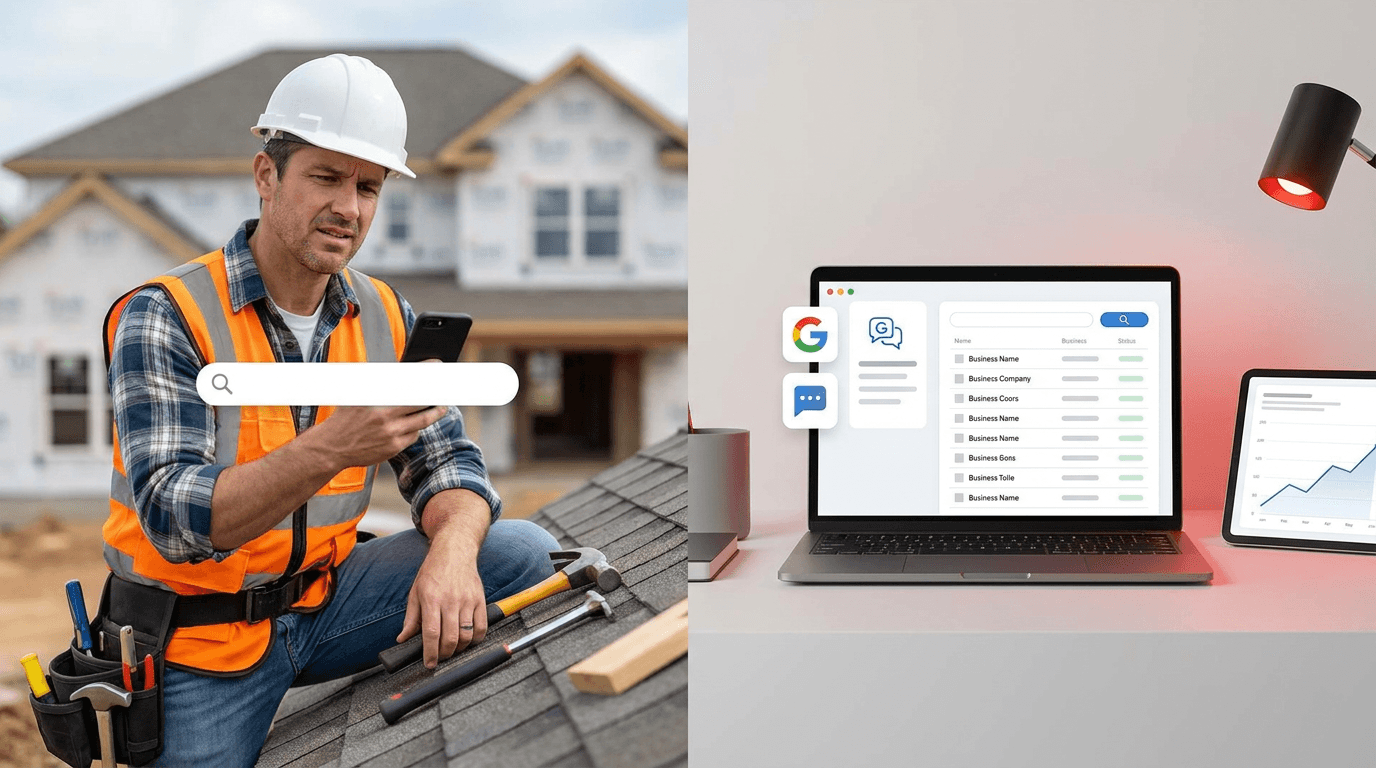
When a homeowner asks ChatGPT "who's the best roofer near me?" or Google's AI Overview summarizes options for "emergency HVAC repair," your business either gets mentioned—or it doesn't. For many trades, that moment is now the first step toward a booked job.
AEO (Answer Engine Optimization)—also called AI SEO—is how you make your business easy for AI search tools to find, understand, and recommend. Traditional SEO helps you rank on a results page. AEO helps you get named inside the answer when someone never clicks a link at all.
If you run a roofing, HVAC, plumbing, landscaping, or remodeling company, this guide is for you. Not the theory of search marketing—the practical question: what do you actually need on your website and online profiles so AI points homeowners your way?
What Is AEO?
AEO is the practice of structuring your online presence so AI systems—Google AI Overviews, ChatGPT, Perplexity, Claude, Gemini, and Copilot—can extract clear information about your business and cite you as a source.
You'll hear the same idea called AI SEO or generative engine optimization (GEO). The labels differ; the goal is the same: when a homeowner asks an AI a question, your business shows up as a credible option.
Research presented at KDD 2024 (Princeton's GEO study, tested on Perplexity) found that content with statistics and cited sources can see up to 40% higher AI visibility. Keyword stuffing, on the other hand, reduces visibility by about 10%. AI systems reward specific, clear answers—not repeated city names and superlatives.
Traditional SEO vs. AEO: What's the Difference?
You still need both. Local SEO gets you on the map. AEO gets you into the summary.
| Factor | Traditional SEO | AEO | | ----------------------- | -------------------------------------------------------- | --------------------------------------------------------------------- | | Primary goal | Rank in Google search results | Get named in AI-generated answers | | What success looks like | Clicks to your website | Your business mentioned with a link—or without one | | What matters most | Keywords, backlinks, page speed, Google Business Profile | Extractable answers: FAQs, service details, reviews, structured pages | | Where AI looks | Mostly your website + local pack | Your site, reviews, directories, videos, and third-party mentions | | Content freshness | Important | Heavily weighted—outdated pages lose to current ones |
Bottom line: A fast website and solid Google Business Profile still matter. But if your site only says "quality workmanship since 1998," AI has nothing useful to quote—and homeowners move on to a competitor who spelled out what they actually do.
Why Home Service Owners Should Care
Your customers are already using AI to research before they call. They're not typing your company name. They're describing a problem and looking for someone local they can trust.
Common searches that lead to a phone call:
- "Who is the best roofer in [city]?"
- "How do I choose a reliable HVAC contractor?"
- "Emergency plumber open now near me"
- "How much does a kitchen remodel cost?"
- "What should I look for when hiring a landscaper?"
When AI answers those questions, it pulls from businesses that publish specific, verifiable details—not the company with the nicest logo. Service area. Services offered. Licensing and insurance. Reviews. Pricing signals. How to book. What happens after you call.
If that information lives only in your head—or across scattered review sites with no website to tie it together—you're harder to recommend, even if your crew does great work.
How AI Chooses Which Business to Recommend
Think of it from the homeowner's side. They ask one question. AI needs to return a useful answer fast. It looks for content it can quote in one or two sentences without guessing.
That usually means:
- Your Google Business Profile — Complete services list, accurate hours, photos, recent reviews, and correct categories.
- Your service pages — Dedicated pages for what you actually do ("water heater repair," not just "plumbing").
- Your website copy — Plain-language descriptions of your process, service area, and what a customer should expect.
- Reviews and directories — Third-party mentions that confirm what your site claims.
- Helpful content — FAQs, guides, and comparisons that answer the questions homeowners ask before hiring.
You don't need to become a publisher. You need enough structured information that AI can say: "ABC Roofing serves Mississauga and Oakville, offers free inspections within 48 hours, and has 4.8 stars across 120 reviews"—and link to you.
Three Ways to Improve Your AEO
1. Structure Your Site So AI Can Extract Answers
AI doesn't read your whole homepage. It pulls passages—short blocks it can drop into an answer.
Formats that work for home service businesses:
- Clear service descriptions — Lead with what you do and who it's for. Example: "We install and repair tank and tankless water heaters for homes in the Greater Toronto Area. Most replacements are completed in one day."
- FAQ sections — Answer what homeowners actually ask: "Do you offer emergency service on weekends?" "How much does a roof inspection cost?" "Are you licensed and insured?" Keep each answer to 50–100 words.
- Comparison content — "Repair vs. full roof replacement" or "Central AC vs. ductless mini-split" gives AI structured information to summarize.
- Process pages — "What to expect during a kitchen remodel" or "How our HVAC tune-up works" builds trust and gives AI quotable steps.
Simple rules:
- Put the answer in the first sentence under each heading.
- Use headings that match real searches ("Emergency Plumbing in [City]," not "Our Commitment to Excellence").
- One idea per paragraph. Cut the filler.
Your homepage matters, but individual service pages are where most contractors fall short. A single page listing ten services in bullet points gives AI almost nothing to work with.
2. Build Authority With Specifics, Not Slogans
AI prefers sources it can trust. You don't need national press—you need concrete details a homeowner (or an AI summarizing for them) can verify.
What to include on your site and profiles:
- Service area — Name the cities and regions you actually cover.
- Credentials — License numbers, insurance, manufacturer certifications, years in business.
- Proof of work — Before/after photos, named testimonials, project types completed.
- Pricing signals — Ranges, starting prices, or "free estimate" details. AI struggles to recommend businesses with zero pricing context.
- Freshness — Update pages when services, hours, or offerings change. Add a "last updated" date on key content.
What doesn't help:
- "We're the best in town" with no supporting detail.
- Stock photos and vague promises.
- A contact form with no explanation of what happens after someone submits it.
Compare these two lines. Only one gives AI something to cite:
- ❌ "Quality service you can trust."
- ✅ "Licensed and insured HVAC contractor serving Hamilton and Burlington. Same-day emergency calls, free estimates on system replacements, 4.9-star rating on Google."
3. Show Up Beyond Your Website
Here's what catches many owners off guard: AI often cites third-party sources more than your own site. Reviews, directories, YouTube, and local roundups all feed into whether you get recommended.
Where to focus:
- Google Business Profile — Treat it as important as your homepage. Post updates, respond to reviews, keep services and hours current.
- Review sites — Google, Yelp, and trade-specific directories. Detailed reviews ("they came within an hour," "explained the repair clearly") give AI real language to work with.
- Video — Short walkthroughs ("what we check during a roof inspection") show up in AI Overviews and build credibility.
- Local directories and associations — Chamber of commerce, trade association listings, and legitimate "best of" roundups in your market.
Your website is the hub. Your reputation across the web is what backs up what it says.
AEO Checklist for Your Business
Run through this on your homepage, service pages, and Google Business Profile:
| Check | Pass? | | --------------------------------------------------------------------- | ----- | | Each major service has its own page with a clear description | | | Service area is listed explicitly (cities/regions, not "local area") | | | Licensing, insurance, or certifications are visible | | | FAQ section answers common homeowner questions | | | Phone number and contact method are easy to find on mobile | | | Google Business Profile matches your website (services, hours, phone) | | | Recent reviews mention specific work or outcomes | | | Pages load fast and read well on a phone | | | Key pages have visible dates or recent updates | | | AI crawlers aren't blocked in your robots.txt | |
You don't need a perfect score on day one. Start with your highest-value services—the ones that drive the most calls—and work outward.
Common Mistakes Home Service Businesses Make
- One generic homepage, no service pages — AI can't extract "what you do" from a paragraph that lists everything at once.
- Missing service area — "Serving the GTA" isn't enough. Name the cities.
- No FAQ content — Homeowners ask the same questions on every estimate call. Answer them on your site.
- Neglecting Google Business Profile — Incomplete profiles, old hours, and unanswered reviews hurt you in both local search and AI answers.
- Blocking AI crawlers — Some sites block GPTBot or PerplexityBot in robots.txt. That can prevent those platforms from reading your content at all.
- Keyword-stuffed city pages — "Plumber Toronto" repeated fifteen times hurts readability and AEO alike.
- Outdated content — A 2022 page with old pricing or services loses to a competitor who updated theirs this year.
How to Check If It's Working
You don't need expensive tools to start. Once a month, do this:
- Write down 10–15 searches your customers might use before calling you.
- Run them through Google (look for AI Overviews), ChatGPT (with search on), and Perplexity.
- Ask: Is my business mentioned? Is my website linked? Who else shows up and why?
- Log it in a spreadsheet. Compare month to month.
If competitors appear and you don't, look at their service pages and Google profiles. What details do they include that you don't?
Tools like Otterly AI, Peec AI, or LLMrefs can automate this later. A manual check tells you plenty to start.
Frequently Asked Questions
What is the difference between AEO and traditional SEO?
Traditional SEO focuses on ranking your pages in Google so people click through to your site. AEO focuses on getting your business cited inside AI-generated answers—the summary box, the chat response, the overview panel. Strong local SEO helps AI find you. Clear, structured content helps AI recommend you.
Is AEO the same as AI SEO?
Yes. AEO (Answer Engine Optimization) and AI SEO describe the same practice. You may also see generative engine optimization (GEO). Different names, same goal: show up when AI answers a homeowner's question.
Do I need to rewrite my entire website?
No. Start with your Google Business Profile, homepage, and pages for your top three services. Add FAQs, clarify your service area, and make sure each service page explains what you do in plain language. Small, specific improvements add up.
Will AEO replace Google Ads?
Not entirely. Ads still put you in front of people searching right now. AEO builds long-term visibility—the kind that compounds when homeowners research "how to choose a contractor" weeks before they call. Most businesses benefit from both: a solid online foundation plus ads when you're ready to scale.
Which AI platforms matter most for local trades?
Start with Google (AI Overviews and the local map pack)—that's still where most homeowner searches begin. Then check ChatGPT and Perplexity for the informational searches in your trade ("signs you need a new roof," "how much does AC installation cost"). Improvements to your site and profiles tend to help across all of them.
I'm busy running jobs. Is this worth my time?
You're already losing calls to competitors who are easier to find online. AEO doesn't require a blog post every week. It requires accurate service pages, a complete Google profile, and enough detail that a homeowner—or an AI acting on their behalf—can confidently choose to call you. That's worth an afternoon of cleanup.
Start With What Homeowners Need to Know
AEO isn't a separate marketing channel to master. It's a reason to fix the gaps that already cost you jobs: vague service pages, incomplete Google profiles, and websites that look fine but say almost nothing useful.
The contractors who show up in AI answers are the ones who made it easy to understand what they do, where they work, and why someone should call them. That's good business practice whether a human or an AI is reading.
Take an hour this week. Pull up your site on your phone. Read it like a homeowner who's never heard of you. If you can't quickly answer "what do they do, do they serve my area, and how do I reach them?"—neither can AI.
If you want help auditing your site or building service pages that answer those questions clearly, the team at Gray Tech Solutions can help. Contact us for a free consultation.